The Legendary UNITAS 6497

The Legendary UNITAS 6497
Showing posts with label SOMETHING TO READ. Show all posts

Thursday, December 16, 2010

Dream Factory...the place where Grand Seiko is made


I found this article somewhere stashed on the internet, might be very interesting for all us dreaming to own a Grand Seiko. You might not be able or afford to own it now, but do not forget that dreaming of having a GS is not a bad thing. This is about a factory, the place where Grand Seiko is made. Nothing technical here, all are facts related to "the finest of a very fine Japanese watch". Start reading.
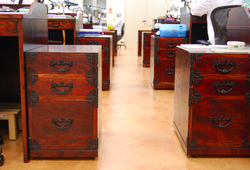
Tucked away in a seemingly remote wooded part of Japan, near the town of Morioka, sits a world-class watchmaking facility that has been quietly producing some of the world’s finest mechanical watches for over 70 years.

Called the Shizukuishi Watch Studio (check out a movie about this studio here), the workshop is distinctly different from any other watchmaking atelier in Europe. Each watchmakers’ desk is custom made out of a local wood called Iwayado Tansu and lacquered to a bright polish. The benches are all made to different heights – custom made specifically to the height of the individual watchmaker. Outside the studio hangs a large sign in Japanese stating “Building in Quality with Painstaking Care”.
Within these workshops, the caliber 9S watch movement series is produced and remains the iconic mechanical caliber of the Grand Seiko collection. In the final steps of the assembly of the 9S, each balance wheel is subjected to final adjustment in a surprising way to ‘lock-in’ the accuracy of the movement.
Rather than having a balance wheel with adjustable screws or a gyromax system, Seiko uses a labor intensive process that leaves very little room for trial and error. The watchmakers painstakingly remove tiny amounts of material from a solid balance wheel in order to perfectly adjust the watch the first time. The result is a balance wheel that is perfectly adjusted and cannot be modified from the beginning. The final adjustment can only be made with the hairspring, a process that is also done manually.
Once the watches are completed, they are subjected to a 17 day quality control test adjusting to temperature and 6 positions. In the end, Grand Seiko mechanical watches are accurate to -3 to +5 seconds per day compared to COSC at -4 to +6 seconds perday. Consequently, a mechanical Grand Seiko can hold its own with any Swiss chronometer.
To exemplify the degree of hand finishing that goes into a Grand Seiko, we were given the chance to participate in the “Varnishing Experience”. We were each given a Grand Seiko rotor with our initials hand engraved by Seiko’s master engraver and we were taught how to varnish the engraved Grand Seiko logo with shellac before final polishing. It was a nice way to see how the engraved portions of a rotor or bridge are elegantly colored – and it also made for some interesting photo ops.
The second watchmaking studio we visited was in the depths of Japan’s central mountains near Nagano. Known as the Shinshu Studios, this massive workshop is where a number of high-grade Seikos calibers areassembled including the Spring Drive 9R series and high grade quartz 9F series, used exclusively for Grand Seiko.
The Shinshu studios are composed of three workshops: the Mastery“Takumi” Studio, the jewelry setting studio (mostly for Credor), and the Micro-Artist studio. Here we learned how about the various finishes that are used on Seiko bridges, plates, rotors, etc. such as perlage, sunray finish, circular finish, and even Geneva Stripes. We also saw where Seiko dials are made from scratch for Grand Seiko and we visited Seiko’s most exclusive high-end watchmaking atelier.
Hidden under a flight of stairs, a la Harry Potter, a workshop of small size and massive importance produces some of the greatest works of Japanese horological art. It is simply known as the Micro-Artist Studio. It is within this studio, the master craftsmen produce the Credor Sonnerie, a repeating wristwatch that you have to listen to in order to understand.
On the wall is a small sign written in Japanese that shares the philosophy of this studio “Our watches bring long-term satisfaction, the feeling of Japanese and are reliable to wear until Grandchildren.” Truly the words of the watchmakers, not the marketers.

Monday, November 22, 2010

Monorex


You might also find the word "Monorex" on Rado dial, here it is.

Incabloc...


A friend of mine ask me what Incabloc is, refer to this sheet.

Sunday, August 22, 2010

Identify your Rado

You need these things : eye loupe and case opener

  1. Inspect the vintage Rado watch dial with a jeweler's loupe. At the top of the dial under 12 o'clock, the name "RADO" is embossed in raised capital letters. Models from the 1950s have "RADO" painted. The letters are grouped tightly but evenly spaced.

  2. Examine the red and silver anchor symbol on 1960s and later models. The anchor should rotate. If it's fixed, the Rado may be a fake.

  3. Examine the acrylic crystal on pre-1980s models. A tiny anchor logo should be in the center. A missing anchor may indicate a watchmaker replaced a damaged crystal at some time.

  4. Examine with the loupe the model designation. A Purple Horse model is accompanied with a horse emblem. However, some counterfeits may use a Gazelle emblem from the Gazelle model on a Purple Horse model.

  5. Inspect the crown, which is the slotted twisting knob on the case edge at 3 o'clock. A raised letter "R" is featured on all models manufactured until about 1958. A raised anchor symbol is used on post-1958 models. Keep in mind that it took Rado a couple of years to make a full transition from an "R" crown to an anchor crown. It's also common to replace crowns over the years. Finding a generic crown on an older Rado is common.

  6. Use a case blade to pry open a Rado with a snap case back. Use a rubber jar opener to rotate counterclockwise a screw case back. Remove the case back and inspect with a jeweler's loupe the movement. The movement is a small engine that regulates the timing of the watch. All post-1957 Rado movements are clearly stamped with the "RADO" logo. All movement parts on the movement should have the same discolored aging on older models.

  7. Examine the stainless steel bracelet. Original Rado bracelets have the "Novavit SA" triangle logo stamped on the inside. Replacement bracelets have no such logo.

  8. Done !!!


  • 2

    Examine the red and silver anchor symbol on 1960s and later models. The anchor should rotate. If it's fixed, the Rado may be a fake.

  • 3

    Examine the acrylic crystal on pre-1980s models. A tiny anchor logo should be in the center. A missing anchor may indicate a watchmaker replaced a damaged crystal at some time.

  • 4

    Examine with the loupe the model designation. A Purple Horse model is accompanied with a horse emblem. However, some counterfeits may use a Gazelle emblem from the Gazelle model on a Purple Horse model.

  • 5

    Inspect the crown, which is the slotted twisting knob on the case edge at 3 o'clock. A raised letter "R" is featured on all models manufactured until about 1958. A raised anchor symbol is used on post-1958 models. Keep in mind that it took Rado a couple of years to make a full transition from an "R" crown to an anchor crown. It's also common to replace crowns over the years. Finding a generic crown on an older Rado is common.

  • 6

    Use a case blade to pry open a Rado with a snap case back. Use a rubber jar opener to rotate counterclockwise a screw case back. Remove the case back and inspect with a jeweler's loupe the movement. The movement is a small engine that regulates the timing of the watch. All post-1957 Rado movements are clearly stamped with the "RADO" logo. All movement parts on the movement should have the same discolored aging on older models.

  • 7

    Examine the stainless steel bracelet. Original Rado bracelets have the "Novavit SA" triangle logo stamped on the inside. Replacement bracelets have no such logo.

  • Friday, August 6, 2010

    Something on Pronounciation -back to school

    Try to pronounce these : I mean correctly pronounced

    1. Audemars Piguet
    2. Blancpain
    3. Ikepod
    4. Breguet
    5. Hublot
    6. Jaeger-Le Coultre
    7. Patek Philippe
    8. Paul Picot
    9. Piaget
    10. Universal Geneve
    11. Vacheron Constantin

    The answer is :

    1. awe-de (short e on de)-MARR pee-GAY
    2. BLONK-pan (very soft n on the end)
    3. Ikepod-- I have no idea (long I-key-pod?)
    4. BRE (short E)-gay
    5. HEW-blow
    6. yay-GER le-COOL-tre (short e on the end)
    7. pat-ECK phil-LEAP
    8. paul PEE-coe
    9. PEE-ah-jay
    10. u-knee-ver-salle (short a, short e)GEN-ev
    11. VACHE-err-on CON-stan-tn
    12. E (long E, pronounced like a long A)tah

    Enjoy your weekend.

    Sunday, February 21, 2010

    Short Risalah 8 - Patek and Veyron


    Ok, I found this article somewhere on the internet. Let me summarize and just read. I am speechless now. This is Patek Caliber 89, tagged at USD 5,129,000.00. This price is equal to 3.5 Bugatti Veyrons, which happens to be 70% of Veyrons sold in 2005. So what makes this watch cost USD 5.13 million ? Could it be with 33 complications ? You need bags and years of experience and Degree in Mechanical Engineering to produce this watch. God bless you.

    Sunday, December 20, 2009

    Short Risalah 7 - USD 25,000,000.00

    Honest. Read the above title carefully. Twenty five million.

    Priced at $25 million, the watch is probably the most extravagant accessory yet. What makes the Chopard watch exclusive? The antique look, 201 diamond carats and all of the logo give this accessory more value than most apparel. The watch flaunts the timeless appeal of diamonds and time keeping.
    Chopard enables you to flaunt a small bouquet of diamonds on your watch to have contemporaries eat their heart out. The extremely beautiful and luxurious watch is worth the last dollar of all the $25 million. This classic is as unique as any natural gem on the planet and also as expensive. The delicate external façade amply compliments the state of the art craftsmanship that holds well within. The investment is an heirloom and the extravagance is all about celebrating life and the good times.
    The 201 carat diamonds are set against a backdrop specially designed for the expensive add-ons. In house craftsmanship has made time management and reading a beautiful indulgence. The watch does not call, it demands attention. The straps and the dial are created to compliment good taste. The watch is a jewel and is rightly treated as one.
    Chopard has lived up to the company’s commitment to ‘delivering nothing but the best’. The watch is a show of integrity and class. It is flaunted as one at some the world’s most exclusive accessory outlets. The casing and the price tag speak volumes for the effort and value the creators themselves have given the watch. The gem is rightly called so!

    Thursday, December 3, 2009

    Short Risalah 6 - Swiss Made $$$?

    Mechanical movements
    Most watches have mechanical movements made largely by hand. These movements can require hundreds of hours of labor, and can only be made by watchmakers with many years of experience. The more complicated a mechanical watch is, the more functions it has, the more you will have to pay for it.

    Material Plating
    Some watches are plated with, or made entirely of precious metal: gold, or even platinum. These metals cost much more than plastic, stainless steel, or base metal. Furthermore, the gold used in Swiss watches is finer than that used in most jewelry sold in the US (18k vs. 14k) so the cost is even higher than you think. The cost is even more if the watch bracelet, as well as the case, is made of precious metal.

    Water resistance
    Water resistance also adds to the cost of a watch. Making a watch watertight requires gaskets perfectly fitted to keep out water and, often, a special type of crown that screws down into the case so water can’t seep in. The higher the level of water resistance (100m, 200m or whatever) the lower the manufacturing tolerance and the more expensive the case.

    Limited Edition
    Most Swiss companies have short production runs because they make watches for a narrower market than the firms in the orient. This allows them to provide more exclusive designs to customers, but also drives up manufacturing costs.

    Material of Crystal
    Just about all watch parts are available in a range of qualities. A watch made with a synthetic sapphire crystal, which is very difficult to scratch and highly durable will cost more than one with a plastic or a glass crystal.

    Casing
    Swiss watches in general have more unusual and complex case designs than less expensive watches. This means they are constructed of more parts, requiring a wider variety of dies to produce them and a more time consuming assembly process.

    Others
    Other features also affect a watch’s price. A smoothly finished, supple link bracelet will cost more than a roughly finished one. A double safety buckle on the band will add to the cost, as well as special finishes on the case or dial.

    Labour Cost
    They are paid at an average salary of EUR 55.00 per hour..........Please correct me if I am wrong.

    Short Risalah 5 - Crystals, crystals and crystals

    The crystal is the transparent protective covering that fits over the watch face, and is held in place by the bezel. It’s exposed to all manner of shocks and blows, so it should be as hard as possible. Softer materials scratch and break easily, making the watch less attractive and possibly unreadable. Worse, they could shatter and damage the watch beyond repair.
    A crystal can be made from any clear material, from plastic to synthetic sapphire – the hardest and most expensive crystal available. The short notes below shows popular crystal types and their relative hardness.

    Plastic : Does not resist scratches
    Mineral : Hardened glass, resists some scratches
    Synthetic sapphire : Hardened glass with a sapphire coating to help resist scratches
    Sapphire : Scratch resistant and very hard-wearing

    Monday, November 16, 2009

    Short Risalah 4 - The Famous Unitas 6497


    In 1898, Auguste Reymond established his watch company, Manufacture Auguste Reymond in the small town of Tramelan in the center of the Jura Mountain region of Switzerland. He also began to manufacture movement blanks, or ebauches, in 1906. Reymond later gave the name of these ebauches UNITAS, after the UNITAS Watch Company he acquired in 1926. The Depression precipitated by the American Stock Market crash of the late 1920s and early 1930s was felt throughout Europe. The Depression had a profound effect on the Swiss watch industry and August Reymond S.A. did not go unscathed. Sales of his watches plumeted and Reymond was forced to sell his company to a group of investors who managed to keep the company financially viable.

    Fortunately, Ebauches SA had been formed in 1926 in Neuchatel as a holding company that brought together Switzerland's largest ebauche firms, which included Valjoux S.A., ETA S.A., Felsa S.A., Venus S.A. and others. Fabrique d'Ebauches Unitas S.A. joined this confederation in 1932. Ebauches SA proved vital to the survival of the ebauche industry in Switzerland. Naturally, Reymond did not make Unitas movements for his watches only, but sold them to other watch manufacturers in Switzerland, just as other ebauche manufacturers did. This helped the company's financial bottom line.

    His watch firm's complete name, Auguste Reymond, S.A. was the source of the name for his watches, the acronym ARSA. Reymond also manufactured watches under the UNITAS name. Each Swiss ebauche is stamped with its own unique symbol to identify the manufacturer. The Swiss adopted a stylized shield, within which the ebauche manufacturer would place a letter or letters, or a symbol. The UNITAS stamp used the letter U with a T within, placed within the shield outline (above photo). The caliber number was also stamped on the ebauche.

    ARSA pocket and wristwatches and UNITAS wristwatches were coveted for their accuracy and appreciated for their affordability and style. Over the course of the 20th century, many travelers to Switzerland who owned these watches would travel by train to Tramelan to see the Manufacture Auguste Reymond and perhaps peer into the workshops to see the master watchmakers at work.

    In the early 1930s, the Incabloc® movement shock absorber was developed, and it revolutionized movement durability and maintaining accuracy. It was adopted by virtually all Swiss movement manufacturers. It has been refined over the decades since and is the premier method of protecting Swiss watches from severe shock. UNITAS incorporated the Incabloc® system in their movements. Among them is the UNITAS 6497 and 6498 pocketwatch movements designed in the 1950s. The 6497 and 6498 calibers became regarded as among the best pocketwatch movements ever designed for their ruggedness and accuracy.

    Along with the UNITAS 6497 and 6498 movements, the company also developed braille wrist and pocket watches for the blind, and a line of "jumping hours" watches with unique hour indication on the dial which were also developed during the 1950s. The fifties, sixties and seventies were the golden decades of Swiss watchmaking when the industry experienced unprecedented prosperity. The August Reymond S.A. building had become landmark in Tramelan and one of the largest employers in the town. However, a technological revolution was brewing that would shake the Swiss watch industry to its foundations.

    When SMH was formed in 1983, Ebauches SA became ETA SA Fabriques d'Ebauches. This proved vital to the survival of the watch industry with the onslaught of the quartz revolution in the late 1970s and early 1980s. Auguste Reymond S.A. however, did not survive the arrival of inexpensive and highly accurate quartz movements. Sales of mechanical watches plunged while watches with quartz movements soared. The company had to be liquidated and its assets sold off. The tools and related equipment for the UNITAS 6497 and 6498 pocket watch movements were acquired by ETA. With the consolidation of the Swiss watch industry during this tumultuous period, many smaller watch companies closed their doors, unable to compete with inexpensive Japanese quartz movements. When Ebauches S.A. absorbed Unitas, Valljoux and other manufacturers within ETA S.A, many of the original ebauche names and calibre numbers were retained. That is why today, the UNITAS 6497 and 6498 calibers and the Valljoux 7750 and 7751 calibers manufactured by ETA still carry the name and caliber number of the original ebauche manufacturer.

    Fortunately, James Choffat, a former manager of the company, managed to purchase much of the company's parts, movements, tools and equipment in an effort to keep the Auguste Reymond name alive. It was no longer feasible for the surviving company to remain in the same building it had occupied since 1910. Manufacturer Auguste Reymond moved from its original building to a smaller, more modern building in Tramelan and in 1989 the company was purchased by Nitella S.A. another watch factory in Tramelan. Today, it is under the direction of Thomas Loosli. Many of the newer models in the Auguste Reymond catalog are his designs.


    The UNITAS 6497 is experiencing a resurgence today as a movement for wristwatches. At a whopping 16.5 ligne, it requires a massive case--just the thing for those wanting a manly watch. Both the UNITAS 6497 and 6498 movements remain the premier movements for mechanical pocket watches. A couple of years ago, Auguste Reymond began to offer a limited edition series of wristwatches, using original, new old stock UNITAS movements that have been, in the words from their current catalog, "...thoroughly restaured, redecorated and individually numbered." The limited edition model for 1999 was the Ballad, using the UNITAS 6580 hand-wound movement manufactured in the 1960s with date at three oclock and small second hand at six oclock. The Ballad features a rectangular, sculpted case with round saphire caseback so the beautiful 17 jewel movement can be seen. Production was limited to 999 pieces. The creativity and quality of August Reymond pocket watches and wristwatches will ensure this company will be around well into this new millennium.

    Monday, November 9, 2009

    Short Risalah 3 - Quartz or not to Quartz

    TO QUARTZ OR NOT TO QUARTZ

    A potential wristwatch collector should know that wristwatches sold nowadays are powered either by a mechanical movement or a battery. The former is referred to as a "mechanical watch" (with either an automatic or manual winding mechanism) and the latter is simply called "a quartz". There is a class of watches powered by "kinetic energy" and they will be discussed later.
    Mechanical wristwatches made an appearance in the late 1700s and Queen Elizabeth I was known to wear one decorated with precious jewels. By 1928 mechanical wristwatches were outselling pocket watches.
    Of course, all early wristwatches had a mechanical movement but a dramatic change occurred in 1957 when Hamilton (an American watch company) replaced the mainspring of the watch with a battery that lasted well over a year. in 1960, Bulova (another American company) made its Accutron model with an exclusive tuning fork system that was powered by a battery. Nine years later, Seiko launched its first quartz watch, the Astron 35SQ which was claimed to be the most accurate watch in the world. Timex of England followed with their quartz model, the Electric. These examples show briefly the early development of quartz technology in watches.
    The 1980s saw the Japanese flooding the world with cheap quartz watches and this marked the beginning of the quartz era. With quartz technology, wristwatches are much easier to make than mechanical watches and they could be mass produced on assembly lines. This made watchmaking cheap and profitable and many new companies (including unscrupulous ones with no experience in watchmaking) jumped on the time bandwagon.
    The Swiss, whose name is synonymous with watchmaking, were too much bound by tradition to be able to accept quickly the concept of a battery powered watch, consisting of a mere electrical circuit and a mundane case assembled on impersonal production lines. To them the quartz was a pariah.
    They were slow to react to the Japanese onslaught but they eventually came up with a savvy answer in the form of Swatch, which we will discuss in detail in a future article. Many famous Swiss watchmaking houses also started to include a line of quartz watches in their catalogues. Names like Rolex and Patek Philippe were the early ones to have quartz watches to offer their customers but there were still a few Swiss watchmakers who looked at quartz with disdain. The famous house of Blancpain advertised as follows. "Since 1735 there has never been a quartz Blancpain watch. And there never will be. Another established Swiss watchmaker, Oris, makes only mechanical watches and advertises this fact.
    However, cheaper production methods created by advances in technology are hard to resist and of the 40.1 million watches exported from Switzerland in 1992, 87.8 per cent of them were quartz.
    Therefore, what should the answer be to the intending watch collector? To quartz or not to quartz?
    I have learnt not to be fond of those battery operated watches unless they are of the cheap variety like those made by Swatch. After all, quartz technology has enabled watchmakers to produce cheap quartz watches and some are sold for less than RM10 each.
    If you intend to buy an expensive watch, you should opt for a mechanical watch consisting of traditional mechanical parts assembled by skilled craftsmen rather than a quartz with an innocuous circuit board, step motor, resonator and a battery of unknown parentage mated together by robots on an assembly line. If you open up a quartz watch and look inside, you will know what I mean.
    While the various movements of a mechanical watch are time tested and their designs well-known to collectors, the quartz movement remains a mystery. When one buys an expensive quartz wristwatch, there is no way of telling whether it has an expensive quartz movement or a cheap one. All that the quartz circuit maker will say is that the movement is "very advanced and accurate" etc and no technical details or circuit plans are disclosed.
    Defenders of quartz will say that constant R & D has improved the quartz movement tremendously and batteries are now fail safe (non-leak) and that some last almost 10 years. Cartier is one upmarket watchmaker which believes in quartz and its latest quartz called 202P, is a very much improved version of its first generation quartz movement. This is used in the latest editions of the Cartier Pasha, Santos, Panthere and Diabolo.
    Rolex has a quartz, the Oysterquartz Day-Date Chronometer in 18-carat gold (with bezel, dial and bracelet set in diamonds) that carries a list price of RM131,083. Patek Philippe's Nautilus with quartz movements are also very upmarket and expensive watches. The Audemars Piquet Royal Oak Championship (dedicated to Nick Faldo) is a limited edition of just 500 watches and it is available only in quartz.
    However, the BIG question remains. Can a quartz watch last as long as a mechanical one? My personal experience says "NO". I bought a Cartier Santos in 1981 for RM2700 and the quartz movement lasted only 5 years. The entire quartz circuit was replaced in 1986 for RM480. Another Cartier (a ladies model) bought in 1982 for RM1300 lasted only 4 years and the entire quartz movement had to be changed twice by the agents in Singapore before the watch could be put right. A Seiko "calculator watch" bought in 1980 for RM900 was declared a write-off a year later due to a faulty battery that leaked into the quartz circuit thus ruining it.
    These three cases involved the early 1st generation quartz movements but I still think that quartz technology has a long way to go and the search for the perfect battery has yet to end. The watch with the mechanical movement will always remain the favourite of watch collectors. True collectors choose an item for its beauty, function and history. The making of a mechanical watch is an art by itself, from the making of the various mechanical parts to its assembly by skilled craftsmen. Many mechanical wristwatches continue to be reliable timepieces today despite having gone through decades of use.
    A quartz movement is no feast for the eyes but take a look at the Patek Philippe Minute Repeater or any other complicated watches and it is to behold true beauty. Even an ordinary mechanical movement (ETA) is pleasing to look at.
    Here is a story of one of my favourite watches in my collection, a mechanical timepiece made by Vacheron Constantin. I bought this watch in Zurich in 1974 and paid a small ransom for it. At that time this watch was billed as the "thinnest automatic watch in the world". I saw the watch while passing a shop window and at once, I knew I had to buy it. It was one of the most exquisite timepieces I have ever seen and owned.
    I was advised that the watch should be sent back to the factory in Switzerland for servicing every two years and I did that diligently until 1990. Sometime in mid 1990, I found that the watch was running fast and I happened to be in Singapore. I took it to a shop in Lucky Plaza which had a sign to say they were authorised agents for Vacheron Constantin. They opened the watch to do the adjustments but the result was worse, the watch ran even faster. No matter what they did for the next few hours, they could not put it right.
    They then contacted the main agents in Singapore who told them that my watch should only be opened and serviced in the factory in Switzerland due to the special caliber 838 movement used. The watch was then sent back to Switzerland and it came back after two months running perfectly. There was no charge for the work as they acknowledged the problem was caused by one of their sub-agent's ignorance. The company wrote me an apology and the letter also stated that the person who re-assembled my watch was the same craftsman who assembled it in 1974. I don't suppose a quartz watch will give you this kind of experience.
    Remember that time is measured by fine caliber movements and not by a leaking battery.

    (This article was first published in the July 1993 issue of Asian Auto, Malaysia's leading motoring magazine)

    my comment: I must believe , this is authentic

    Wednesday, November 4, 2009

    Short Risalah 2 - C.O.S.C.

    C.O.S.C. - contrôle officiel suisse des chronometres
    The C.O.S.C. is a non-profit association. It was created by five watchmaking cantons (Bern, Geneva, Neuchatel, Solothurn and Vaud) as well as the Federation of the Swiss Watch Industry in 1973. It encompasses the laboratories that had been established independently of each other from the late 19th century onwards.
    A chronometer is a timekeeper precise enough to be used as a portable time standard, usually in order to determine longitude by means of celestial navigation. In the world of watches, the term is also attached to those tested and certified to meet certain precision standards. In Switzerland, only timepieces certified by the C.O.S.C. can use the word "Chronometer" on them.

    C.O.S.C. measurement methods:
    Only the movement is tested and the tests bear absolutely no relation to a simulation of watch behaviour and performance when worn.
    The test is divided into 16 days, 24-hour periods. The watch is tested in 5 positions and at 3 temperatures.

    Sunday, November 1, 2009

    Short Risalah 1 - Tourbillon


    A tourbillon, "whirlwind" in French, a type of mechanical clock or watch escapement, was invented in 1795 by Abraham-Louis Breguet. It is designed to counter the effects of gravity and other perturbing forces on the balance wheel, the balance spring and the escapement that can affect the accuracy of a chronometer. This is accomplished by mounting the escapement in a rotating frame, so that the effect of gravity cancels out when the escapement is rotated 180°. The effects of gravity were particularly problematic when pocketwatches were carried in the same position for most of the day. In a tourbillon, the entire escapement assembly rotates, including balance wheel, escape wheel, and pallet fork (anchor). The rate of rotation varies per design but has generally become standardized at one rotation per minute.

    The tourbillon is considered to be one of the most challenging of watch mechanisms to make and is valued for its engineering and design principles. In modern watch designs, a tourbillon is not required to produce a highly accurate timepiece because wristwatches are by nature in a constantly changing position when worn. Nevertheless, the tourbillon is one of the most valued complications of collector's watches and premium timepieces. In fact, modern implementations typically allow the tourbillon to be seen through a window in the watch face. In addition to enhancing the charm of the piece, the tourbillon acts as a second hand as it rotates once per minute.