Thursday, December 3, 2009
Short Risalah 5 - Crystals, crystals and crystals
A crystal can be made from any clear material, from plastic to synthetic sapphire – the hardest and most expensive crystal available. The short notes below shows popular crystal types and their relative hardness.
Plastic : Does not resist scratches
Mineral : Hardened glass, resists some scratches
Synthetic sapphire : Hardened glass with a sapphire coating to help resist scratches
Sapphire : Scratch resistant and very hard-wearing
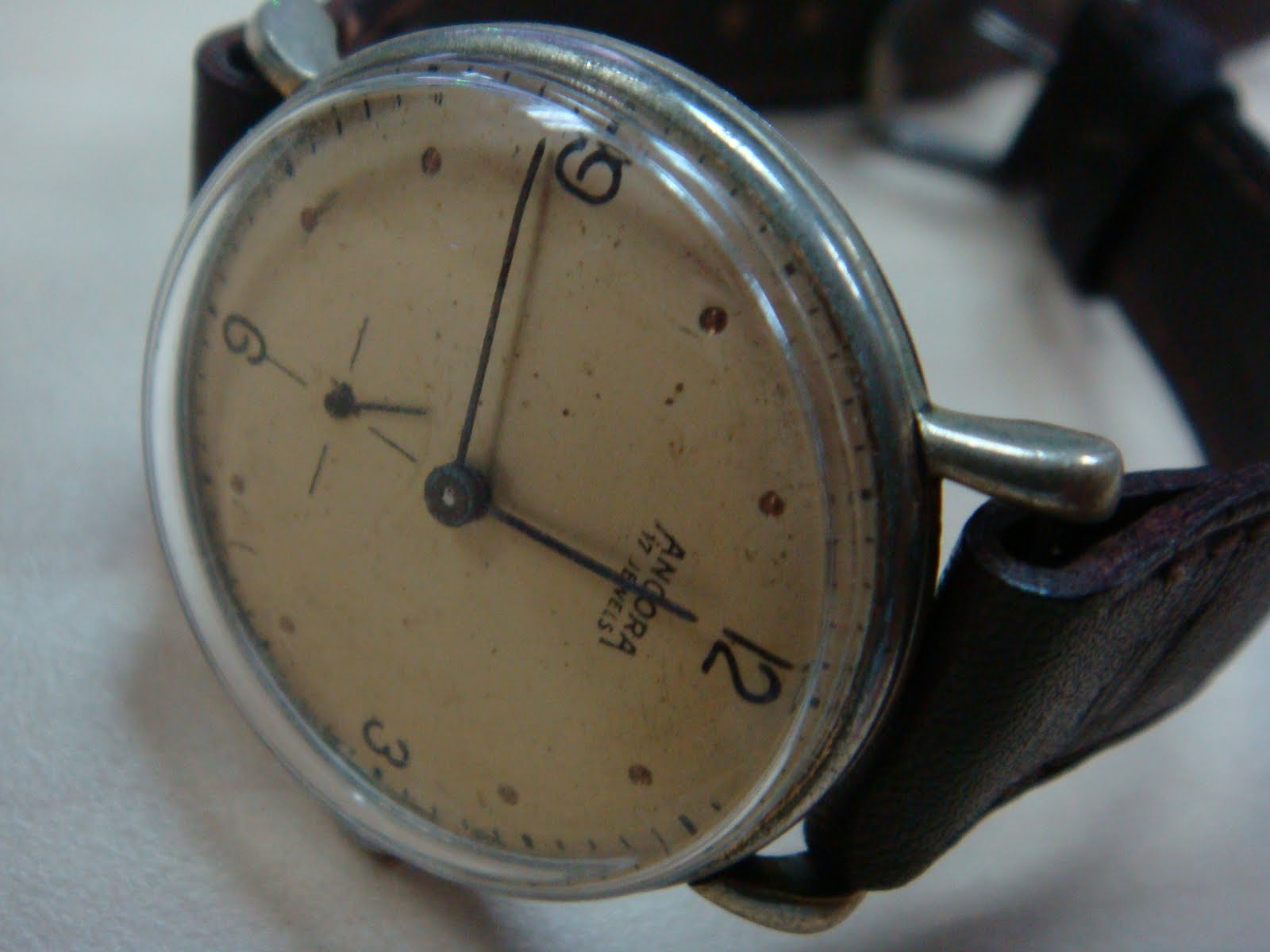
Ancora
Hard to find Ancora. This brand started in the 40's. What I have here is an excellent condition timepiece. Dial is still in "mint" condition. There are a few small dots there on the dials. On the backplate there is stamped 9256. Could it be watch #92, made sometime in 1956 ? Need expert advise please. Diameter is 32mm without crown. Fixed lugs, no spring bars needed.For sale RM 260.
Titoni
Type -- Manual Wind
Movement -- 17 Jewels
Case -- stainless steel
Dial -- original dial
Crystal -- Acrylic
Width(without the crown) -- 34 mm
Length(from lug to lug) -- 43.2 mm
Crown -- signed
Band -- 18 mm, can be fitted with 20 mm band coz the body of the watch is quite wide.
Monday, November 23, 2009
ETA 2390
There is no brand name here. I suppose it is a prototype. Taken away out of factory once it was finished ?. Some facts : Manual winding, 21 jewels, ETA 2390 Swiss made signed movement, waterprotected, stainless steel and antimagnetic. Case width inclusive crown is 35 mm and 40mm from lug to lug. For sale RM 220.
Slava
The Slava 2428 Movement Caliber an interesting feature: two mainsprings instead of only one. It's interesting to note that this is also a mechanical feature of the Lange & Sohne watches; Quick date change calendar. Double Day & Date calendar. This watch made in USSR. Nice pearl dial with gold tone hands. On the dial inscriptions: 'SLAVA', '26 Jewels', 'MADE IN USSR'. The case is chrome plated.
Date prodced : 1970s
2428 Movement Caliber
26 Ruby Jewels
Mechanical, Manual winding-up
Central trotting seconds hand
Double Day & Date calendar
Diameter Movement: 24 mm;
Heights of mechanism - 4,85 mm
Periods of balance fluctuations 0,4 sec
Case size (without crown): 38 mm x 44 mm. Thickness 10 mm
Diameter Dial: 33 mm
Shockproof balance
Dustproof
Stainless steel back
Wristband size: 18 mm
Friday, November 20, 2009
Pobeda
Sold to Mr Shah.
Pobeda Movement - by Andrew Babanin
The history of watchmaking in Russia is not very long. Before the October revolution Russia had to assemble watches from ready parts, imported from Switzerland. It was more profitable to assemble watches in Russia because of tax barriers. For example you pay 4,5 roubles for ready watch or even 6 roubles for the same watch in gold case. And you pay about 0,75 rouble for enormous qty of spare parts. Most famous brands of that period were Henry Mozer, Pavel Bure, Victor Gabu, Freimuth, Kiseleff, Telefon. Some local workshops produced wallclocks and alarm clocks. Nobody even thought about watchmaking formation in tzar Russia.
After the 1917 revolution, the whole watch industry became a part of the ‘Trust of Precision Mechanics’. They were watch enterprises, work shops, warehouses of watch parts and half-finished products which belonged to famous manufacturers, mentioned before. The first time the Soviets assembled watches from the spare parts, left in Russia after the revolution - there were Longines, Zenit, Omega, HM etc.
But to 1926 all warehouses were out of spare parts. Only in 1927th there was a decision to start watch producing in Russia. First Soviet watch had been manufactured in 1930. Primarily Russia used foreign bimetallic balance wheels, bouchons, screws. Then the Soviets began producing their own jewels and balances. I won't say it was a perfect quality - but it was fully made in Russia! This movement (pocket one) came up to WW2.
To start production, the four types of watches were chosen: a man's pocket watch with 15 jewels for the enterprises of the Narkomat (Ministry) of Means of Communications, a man's wrist-watch with 7 jewels for the Red Army; a man's pocket watch with 7 jewels and a ladies' wrist-watch with 15 jewels to sell in a market. For the prototype there had been chosen a French "Lip" movement R43 (43 mm in diameter).
In December, 1941 the most part of equipment and personnel was displaced to Zlatoust in Chelyabinsk region. Until nowadays it produces some stopwatches and AChS-11(AChS (aviation clock) - a chronograph with a second timer and with the movement of a flight time meter. Run duration by one wind up of the spring is 120 hours. Operative temperature range –60oC to +50oC. Produced in different variations from 1933), the modernized 1st MWF pre-war production. Then in 1942 another factory was evacuated in Chistopol. It was incipience of "Vostok" factory. Most of this equipment had left after the war in Chistopol. During the World War Two evacuated the plant stopped producing watches and worked for military aims. After the WW2 there were enough machinery and (more important) many watch specialists to found Chistopol watch plant with "Vostok" trade mark.
According to the agreement (reparations) after the WW2 Russia had got from Germany some equipment, tools, etc. Glashutte factories had lost almost all machinery. It was quite new equipment, so the Russians were able to produce modern movements of that time, using high class of finishing. The 1st Moscow Watch Factory (now Poljot) started producing K-26 ("Pobeda") in 1946. The "Pobeda" movement is based on the well known for us "Lip" R26. It's a VERY reliable movement. Many of them work for 40-50 years! Recently there was a joke among Russian watchmakers: You shouldn't clean "Pobeda" not to spoil a structure of dirt.
The first time "Pobeda" had been manufactured only at the 1st Moscow Watch Factory (1947-1953). Then it started producing more modern watches and displaced "Pobeda" to other factories. There were "Vostok", the 2nd Moscow Watch Factory, ZIM (Zavod Imeni Maslenikova - a watch factory in Samara) and "Raketa". Every manufacture had some changes with the movement. Vostok added calendar and two cap jewels to escape wheel, besides it began producing movements with Incabloc protection. "Raketa" started later, I'd never met "Raketas" with a calendar, but they added to the original movement a central jewel. ZIM produced the cheapest variant of base movement.
It can be funny, but nowadays "Pobeda" is still under production. I do not have any info what plant makes it (Maybe ZIM). The Chinese look like finishing and original design (15 jewels, no central jewel, no shock absorbing device) won't make any pleasure.
Monday, November 16, 2009
Short Risalah 4 - The Famous Unitas 6497

In 1898, Auguste Reymond established his watch company, Manufacture Auguste Reymond in the small town of Tramelan in the center of the Jura Mountain region of Switzerland. He also began to manufacture movement blanks, or ebauches, in 1906. Reymond later gave the name of these ebauches UNITAS, after the UNITAS Watch Company he acquired in 1926. The Depression precipitated by the American Stock Market crash of the late 1920s and early 1930s was felt throughout Europe. The Depression had a profound effect on the Swiss watch industry and August Reymond S.A. did not go unscathed. Sales of his watches plumeted and Reymond was forced to sell his company to a group of investors who managed to keep the company financially viable.
Fortunately, Ebauches SA had been formed in 1926 in Neuchatel as a holding company that brought together Switzerland's largest ebauche firms, which included Valjoux S.A., ETA S.A., Felsa S.A., Venus S.A. and others. Fabrique d'Ebauches Unitas S.A. joined this confederation in 1932. Ebauches SA proved vital to the survival of the ebauche industry in Switzerland. Naturally, Reymond did not make Unitas movements for his watches only, but sold them to other watch manufacturers in Switzerland, just as other ebauche manufacturers did. This helped the company's financial bottom line.
His watch firm's complete name, Auguste Reymond, S.A. was the source of the name for his watches, the acronym ARSA. Reymond also manufactured watches under the UNITAS name. Each Swiss ebauche is stamped with its own unique symbol to identify the manufacturer. The Swiss adopted a stylized shield, within which the ebauche manufacturer would place a letter or letters, or a symbol. The UNITAS stamp used the letter U with a T within, placed within the shield outline (above photo). The caliber number was also stamped on the ebauche.
ARSA pocket and wristwatches and UNITAS wristwatches were coveted for their accuracy and appreciated for their affordability and style. Over the course of the 20th century, many travelers to Switzerland who owned these watches would travel by train to Tramelan to see the Manufacture Auguste Reymond and perhaps peer into the workshops to see the master watchmakers at work.
In the early 1930s, the Incabloc® movement shock absorber was developed, and it revolutionized movement durability and maintaining accuracy. It was adopted by virtually all Swiss movement manufacturers. It has been refined over the decades since and is the premier method of protecting Swiss watches from severe shock. UNITAS incorporated the Incabloc® system in their movements. Among them is the UNITAS 6497 and 6498 pocketwatch movements designed in the 1950s. The 6497 and 6498 calibers became regarded as among the best pocketwatch movements ever designed for their ruggedness and accuracy.
Along with the UNITAS 6497 and 6498 movements, the company also developed braille wrist and pocket watches for the blind, and a line of "jumping hours" watches with unique hour indication on the dial which were also developed during the 1950s. The fifties, sixties and seventies were the golden decades of Swiss watchmaking when the industry experienced unprecedented prosperity. The August Reymond S.A. building had become landmark in Tramelan and one of the largest employers in the town. However, a technological revolution was brewing that would shake the Swiss watch industry to its foundations.
When SMH was formed in 1983, Ebauches SA became ETA SA Fabriques d'Ebauches. This proved vital to the survival of the watch industry with the onslaught of the quartz revolution in the late 1970s and early 1980s. Auguste Reymond S.A. however, did not survive the arrival of inexpensive and highly accurate quartz movements. Sales of mechanical watches plunged while watches with quartz movements soared. The company had to be liquidated and its assets sold off. The tools and related equipment for the UNITAS 6497 and 6498 pocket watch movements were acquired by ETA. With the consolidation of the Swiss watch industry during this tumultuous period, many smaller watch companies closed their doors, unable to compete with inexpensive Japanese quartz movements. When Ebauches S.A. absorbed Unitas, Valljoux and other manufacturers within ETA S.A, many of the original ebauche names and calibre numbers were retained. That is why today, the UNITAS 6497 and 6498 calibers and the Valljoux 7750 and 7751 calibers manufactured by ETA still carry the name and caliber number of the original ebauche manufacturer.
Fortunately, James Choffat, a former manager of the company, managed to purchase much of the company's parts, movements, tools and equipment in an effort to keep the Auguste Reymond name alive. It was no longer feasible for the surviving company to remain in the same building it had occupied since 1910. Manufacturer Auguste Reymond moved from its original building to a smaller, more modern building in Tramelan and in 1989 the company was purchased by Nitella S.A. another watch factory in Tramelan. Today, it is under the direction of Thomas Loosli. Many of the newer models in the Auguste Reymond catalog are his designs.
The UNITAS 6497 is experiencing a resurgence today as a movement for wristwatches. At a whopping 16.5 ligne, it requires a massive case--just the thing for those wanting a manly watch. Both the UNITAS 6497 and 6498 movements remain the premier movements for mechanical pocket watches. A couple of years ago, Auguste Reymond began to offer a limited edition series of wristwatches, using original, new old stock UNITAS movements that have been, in the words from their current catalog, "...thoroughly restaured, redecorated and individually numbered." The limited edition model for 1999 was the Ballad, using the UNITAS 6580 hand-wound movement manufactured in the 1960s with date at three oclock and small second hand at six oclock. The Ballad features a rectangular, sculpted case with round saphire caseback so the beautiful 17 jewel movement can be seen. Production was limited to 999 pieces. The creativity and quality of August Reymond pocket watches and wristwatches will ensure this company will be around well into this new millennium.